
How to Live and Work with AI
A Practical Guide for 2025

As we close out 2025, one topic has dominated the conversation: artificial intelligence. From DeepSeek R1’s groundbreaking application of reinforcement learning to LLMs at the beginning of the year, through mid-year innovations like Cursor and Claude Code leading the Vibe Coding revolution with MCP and Skills building vertical domain agents, to year-end releases of Gemini 3 and Nanobanana Pro integrating seamlessly with Google’s ecosystem—the pace has been relentless.
Even AI luminaries like Andrej Karpathy have admitted they’re struggling to keep up. In this whirlwind, how should everyday people approach AI? From my perspective, the answer comes down to three principles: AI for Brainstorming, AI for Efficiency, and AI for Learning.
AI for Brainstorming: Breaking Free from Experience Bias
We’ve all heard the saying: “I’ve eaten more salt than you’ve eaten rice.” It’s the voice of experience talking—sometimes wisely, sometimes rigidly. The problem isn’t experience itself; it’s when we become prisoners of it, trapped in our own “acre of land” unable to see beyond what we already know.
AI offers an escape route. Trained on the collective knowledge of the internet, books, and human feedback from around the world, AI models represent a simulation of collective human wisdom. With reinforcement learning enabling autonomous reasoning, they can tackle problems that haven’t been solved before.
Think of AI as your personal think tank. Here are two examples:
Example 1: Exploring AGI Perspectives
I asked ChatGPT: “Who has deep understanding and authority on AGI? What are their views?”
The AI summarized perspectives from Sam Altman, Demis Hassabis, Geoffrey Hinton, Yann LeCun, and others. To verify accuracy, I cross-referenced with Claude. This multi-LLM approach gives you a well-rounded view of expert thinking.
Example 2: Expanding Domain Expertise
Suppose you’re a supply chain expert in China, but now you’re facing Southeast Asian markets. I used Gemini’s Deep Research feature with this prompt:
“Act as a Southeast Asian supply chain industry research and solutions expert.
1) Research the current state and pain points of Southeast Asian supply chains.
2) Search for authoritative expert solutions to these challenges.
3) Provide your own detailed solutions.
Data requirement: Last year, December 2024 to December 2025.”
Gemini returned comprehensive analysis including insights from Deloitte, McKinsey, and DHL, plus AI-generated solutions and future outlook. This is brainstorming at scale.
AI for Efficiency: Escaping the Repetitive Task Trap
Modern AI can liberate us from tedious, repetitive workflows. Develop this mental habit loop:
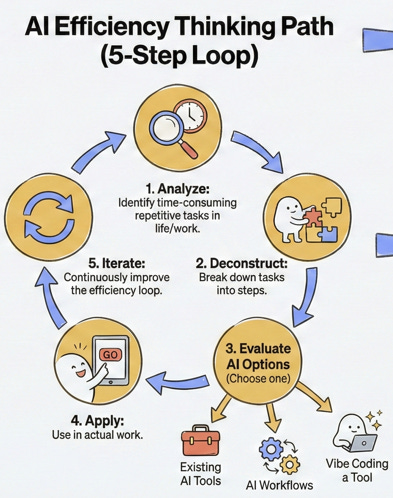
Analyze: Identify time-consuming repetitive tasks in your work or life
Deconstruct: Break down these tasks into step-by-step processes
Evaluation AI Options: Evaluate whether existing AI tools can handle each step—or if you need to build a custom workflow -or Vibe Coding a tool
Apply: Deploy the tool and continuously optimize
Iterate: Continuously improve the tool and your efficiency
My Real-World Example: PowerPoint Translation
My work involves translating numerous Chinese presentations to English. Doing this slide-by-slide is mind-numbing. The challenge? Maintaining original layouts while adjusting font sizes to fit text boxes and avoid overlaps.
I broke this into six steps as below:
Upload a Chinese PowerPoint presentation
Extract text from each slide
Translate to English as a professional in the field
Fill the original text boxes with translated content
Adjust translated text to fit the text boxes
Download the translated PowerPoint
and used Gemini 3 to develop a custom tool. It supports multiple file formats, integrates Google Translate, Kimi, and Gemini for translation (with role-playing capabilities for specialized terminology), and applies formatting rules and template styles. Upload a PPT, configure your API keys and translation roles, and download a properly formatted English version—layout intact, efficiency multiplied.
AI for Learning: Personalized Education at Scale
AI is revolutionizing education, finally delivering on ancient ideals. Confucius’s “teach according to aptitude” and Aristotle’s Socratic method are now achievable at scale. Everyone can absorb knowledge in ways that match their preferences and learning style.
Multimodal Learning
Drop a long research paper or multi-hour video into NotebookLM. In the studio, you can create visual, audio, and text-based learning experiences—choose what works for you.
Gamifiled Learning
Or build a gamified English learning tool through Vibe Coding. Learning doesn’t have to be monotonous; it can be genuinely fun.
Guided Understanding
Enable Gemini’s Guided Learning or ChatGPT’s study mode. Want to understand AI Agents? Ask: “Treat me as a complete beginner and teach me what AI Agents are.”
The AI will use accessible examples, guide you toward answers, and even create diagrams. You’ve just gained a personal tutor.
The Widening Gap
I’ve said this before: AI is creating a bifurcation. Those who effectively use AI become increasingly productive, freeing up mental space for creative and strategic thinking. Those who resist or fail to adopt AI will gradually fall behind. As someone working in this field, I feel this divide intensifying.
That wraps up my final video share of 2025. I’m excited for what 2026 holds and look forward to sharing more insights with you. If you’ve found value in my content, please like, save, and subscribe. Happy New Year, everyone—see you in 2026!