
Palantir Ontology Explained: Why It’s the Operating System for Enterprise AI Agents
How Palantir’s semantic layer turns fragmented enterprise data into a digital twin that LLMs can actually understand — and why Ontology Augmented Generation (OAG) beats RAG for real business decisions

If you’ve been tracking enterprise AI, you’ve noticed a pattern: the models are ready, but the deployments are stuck. Everyone has GPT. Everyone has Claude. Yet somehow, AI inside large organizations still feels like an intern who showed up on day one with no onboarding.
Palantir has an answer. It’s called Ontology — and it might be the most important piece of enterprise infrastructure you haven’t heard of.
Here’s what makes this interesting: Ontology isn’t a database, a dashboard, or a semantic layer with a new name. It’s a digital twin of your entire organization — a living map that both humans and AI can read. And it answers the one question that matters most: how does AI actually understand your business?
Let’s get straight to it.
What Palantir Is (and Isn’t)
A quick primer.
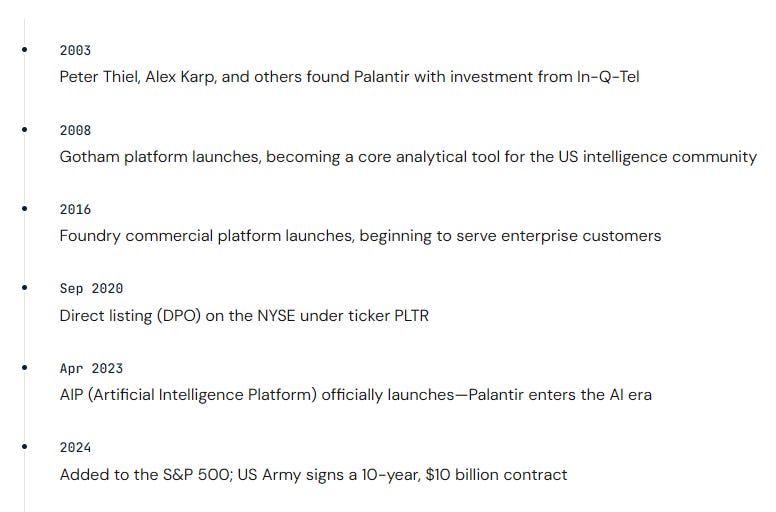
Founded in 2003 by Peter Thiel and Alex Karp (a philosophy PhD), Palantir took its name from the palantíri in Lord of the Rings — seeing stones that pierce space and time.
Their first check came from In-Q-Tel, the CIA’s venture arm. Most Silicon Valley VCs passed.
Today they run three product lines:
Gotham (2008): Intelligence and defense
Foundry (2016): Commercial — Airbus, BP, NHS
AIP (2023): AI Platform, bringing LLMs into the enterprise
NYSE direct listing in 2020. S&P 500 in 2024. $4.48B revenue in 2025.
But the commercial story isn’t what matters here. What matters is the underlying architecture — the thing that makes all three product lines work.
What Ontology Actually Is
Let me start with what it’s not.
It’s not a data warehouse. Not a BI dashboard. Not a data catalog. And it’s not “semantic layer” rebranded.
Palantir’s official definition: “A digital twin of the organization — a semantic layer that sits on top of datasets and models.”
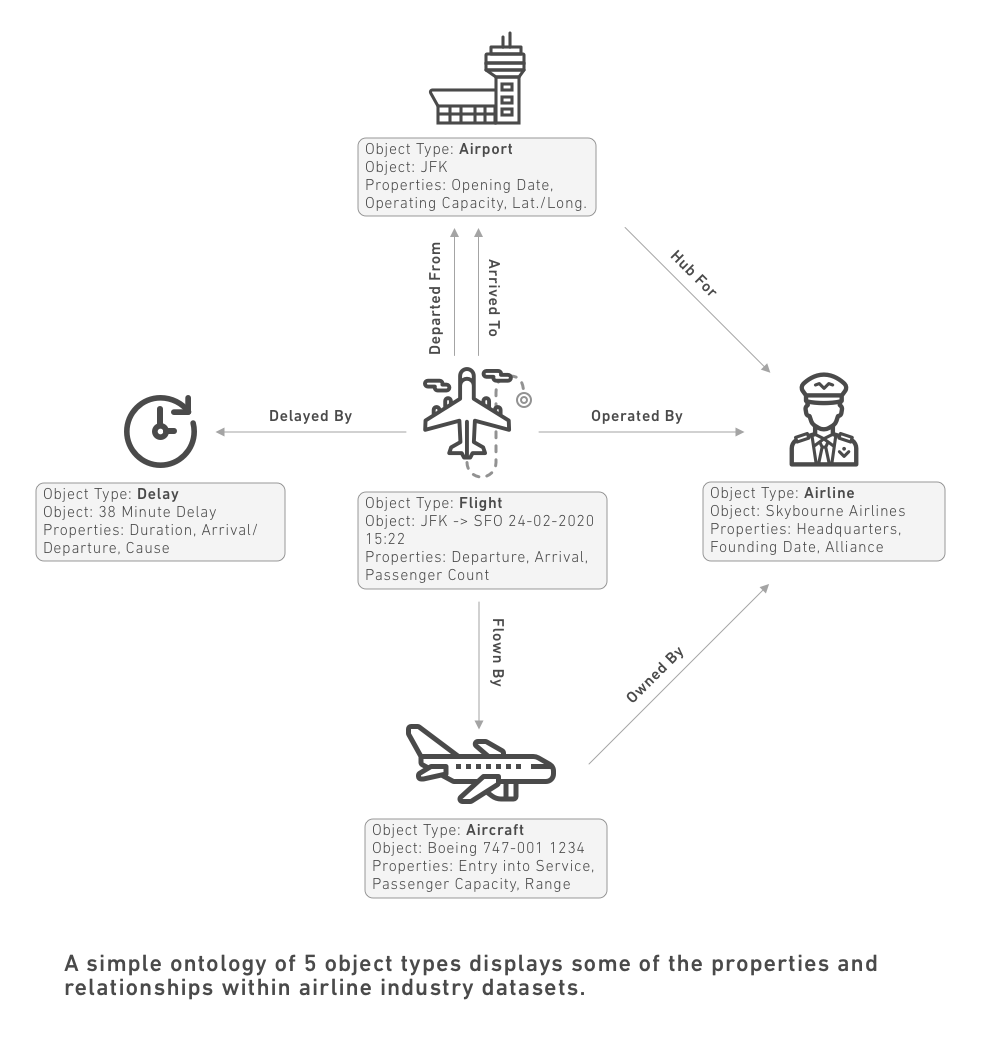
Translation: it weaves your scattered data, business logic, and operational capabilities into a living map that both humans and AI can navigate.
A concrete example
A traditional data warehouse tells you:
“The t_orders table has 5 million rows.”
Ontology tells you:
“Customer Acme Corp’s third order — containing 5 turbine blades, currently in quality inspection at the Hamburg warehouse, linked to DHL tracking #DHL-88492, estimated arrival in Shanghai next Tuesday.”
The difference? Ontology doesn’t just store data. It stitches together fragments from your ERP, CRM, SCM, and IoT systems into a world your business operators can actually understand.
The mapping is straightforward
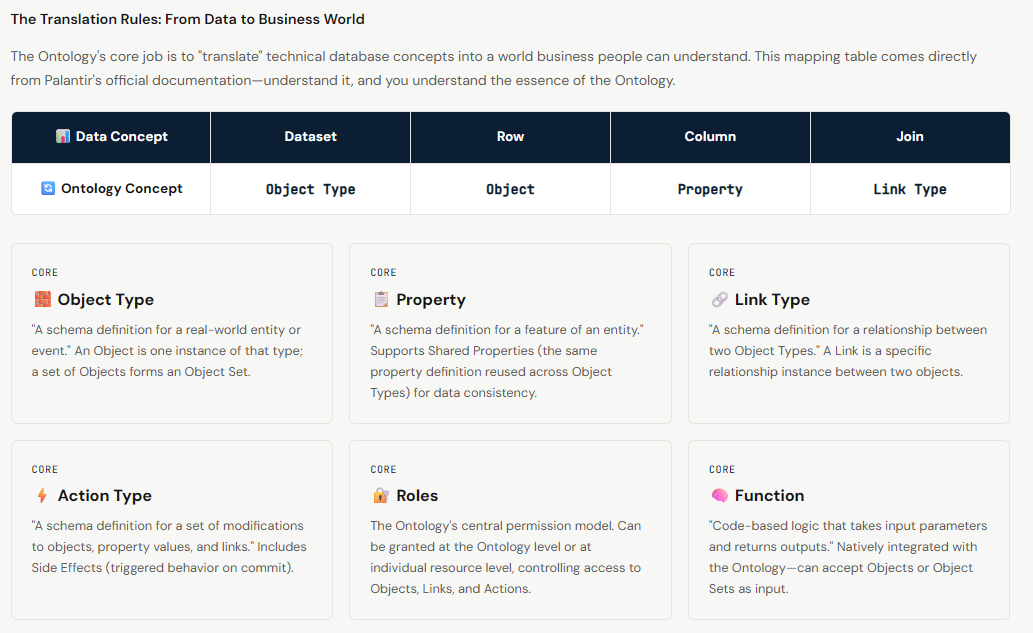
Every technical concept gets “translated” into a business concept.
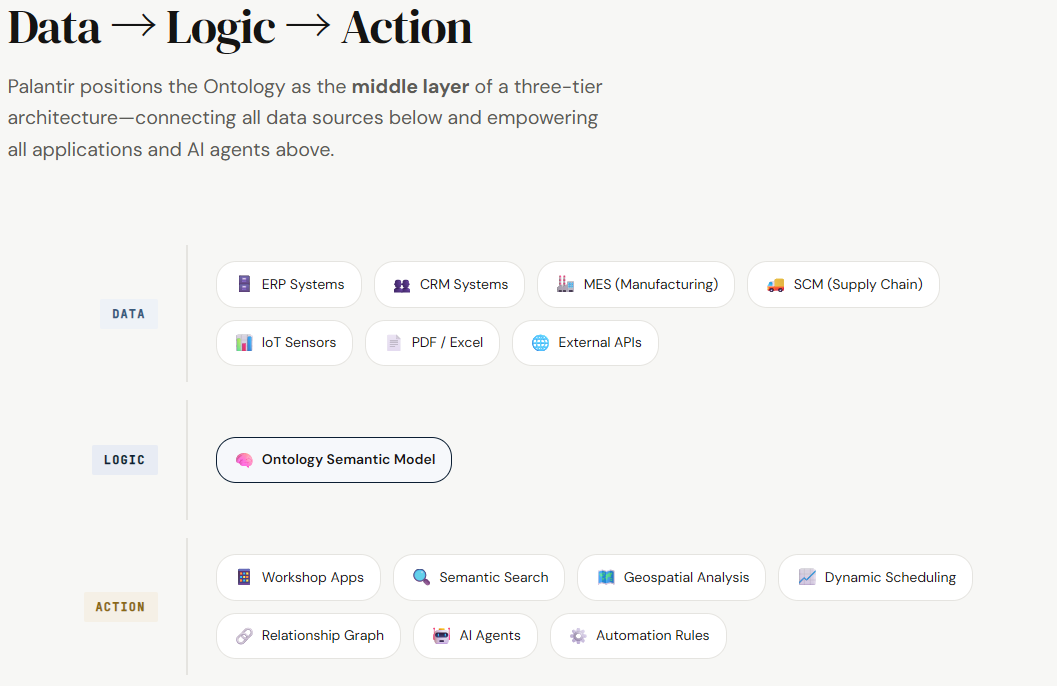
Three-layer architecture
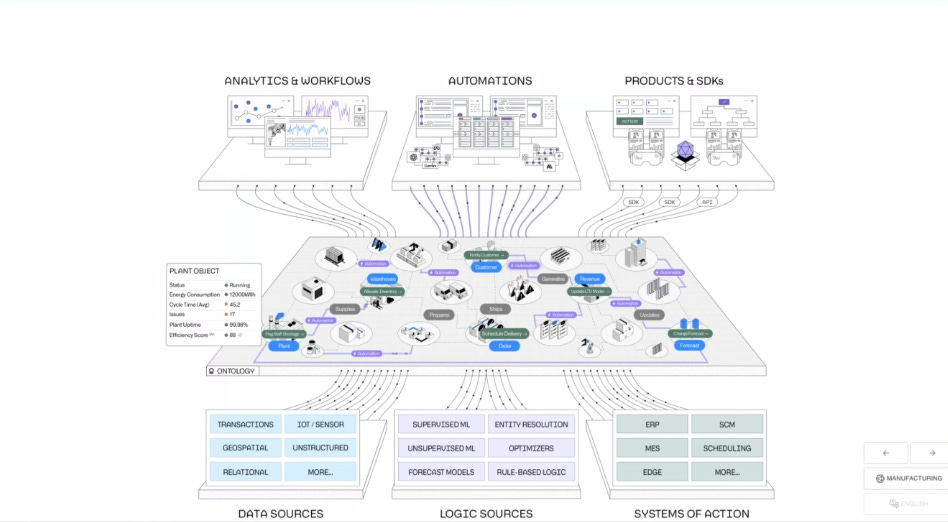
Data Layer (all sources)
      ↓
Logic Layer (Ontology semantic model)  ← the core
      ↓
Action Layer (Workshop, AI Agents, automation)
Ontology is the middle layer. Downward: it connects to all your data. Upward: it powers every application and agent.
A worked example
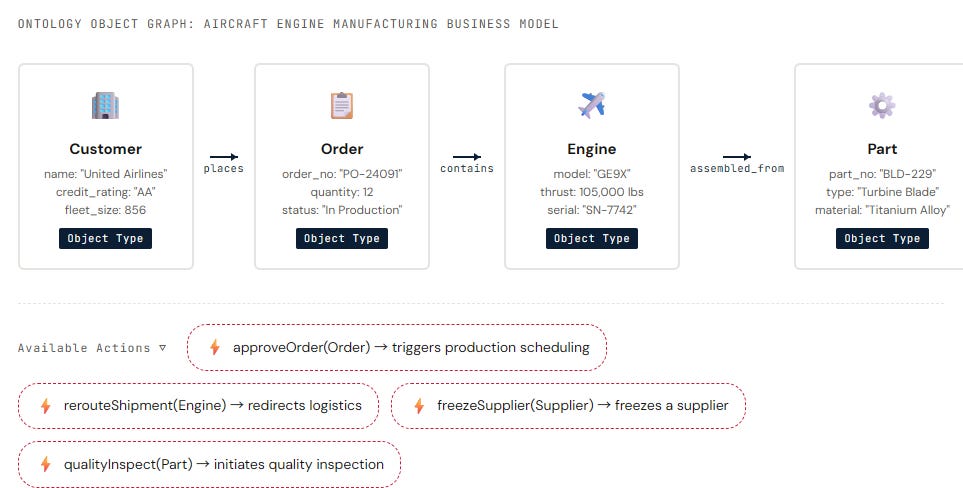
Say you run an aircraft engine manufacturer. Your Ontology has five object types:
Customer → places → Order → contains → Engine → assembled from → Part → sourced from → Supplier
They’re connected by Links. Then you define Actions:
approveOrderrerouteShipmentfreezeSupplier
These aren’t scripts. They’re declaratively defined within the Ontology framework — permissions, validation, and audit trails included.
Build the Ontology once. Every application and AI Agent above it shares the same semantic foundation.
How to build one
Using a supply chain scenario, here are the steps:
Define the nouns — Translate database tables into business objects. A Supplier object has an ID, name, region, lead time, risk score, and so on.
Wire up the brain — Teach the system how to reason. How many days of inventory remain? Which alternative supplier should we engage?
Configure who can do what — Each Action is like a contract: what it does, who can trigger it, under what conditions, and what gets logged.
Think of it as adding buttons to a remote control — each with its own lock, not everyone can press every button.
Once built, humans and AI Agents see the same world. The AI doesn’t just read your data — it understands your company.
Ontology + AIP = AI That Actually Works
This is where Palantir’s 2023 launch of AIP (AI Platform) comes in.
The core insight is simple: an LLM can chat and write code, but if it doesn’t understand your business, it’s forever an intern. Ontology gives AI a complete “employee onboarding handbook” for your enterprise.
OAG (Ontology Augmented Generation)
You’ve probably heard of RAG — Retrieval Augmented Generation.
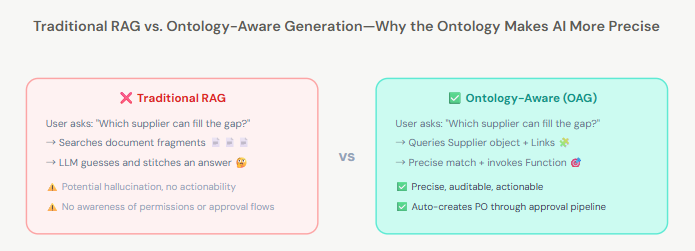
RAGOAGWhat it retrievesText passagesStructured business objects + real-time relationshipsResult qualityLLM guesses and stitchesDeterministic matchReliabilityProne to hallucinationsGrounded in live dataWhat happens nextNothing actionableTriggers approval workflows
Same question — “Which supplier can fill the gap?”:
RAG: Searches docs → LLM pieces together an answer → potential hallucination, no follow-through
OAG: Queries Supplier objects → exact match → auto-creates a purchase order through the approval pipeline
The AIP workflow
Connect to Ontology → Security guardrails (what humans can't see, AI can't see) → Agent executesOne critical design choice: Human-in-the-Loop.
Palantir’s own words: “We don’t sell autonomous driving. We sell a copilot.”
Suggest → Human approves → Execute. That’s the rule.
15 Minutes vs. 3-5 Days
Here’s a real scenario: Supply chain disruption.
Morning alert — a critical component supplier in Southeast Asia is offline due to flooding.
The old way
3 to 5 days. Manually checking 20 different systems, stitching data together, writing reports.
The Ontology + AIP way
15 minutes. Five steps, fully closed-loop:
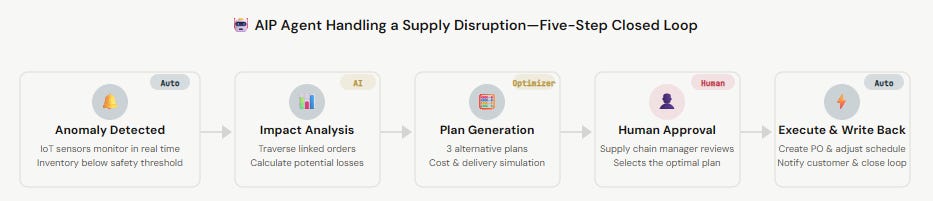
IoT sensors auto-trigger the anomaly alert
AI traverses linked orders and calculates potential losses
Optimization engine generates 3 alternative sourcing plans with cost and timeline simulations
Supply chain manager reviews and selects the best option
Purchase orders are auto-created, ERP is updated, customers are notified — loop closed
This isn’t “AI is smarter than humans.” It’s AI eliminating the pain of manually hunting through 20 systems for data.
Ontology isn’t a “data middle platform.” It’s the operating system for your business in the AI era.
Without it, AI Agents fumble in the dark. With it, they become the most knowledgeable person in your company.
What It Actually Takes
If you’re sold, here’s the reality check.
Implementation path
Discovery → Bootcamp (5 days to first working use case) → Pilot → Go-live → ScaleBenchmark: Nebraska Medicine started in January 2024, deployed their first workflow in under 6 weeks. Subsequent use cases went live in as little as 90 minutes.
The trade-offs
What you get:
Speed: Results in 5 days
Power: Model once, reuse everywhere
Security: Permissions span from data to AI layer, fully auditable
What you risk:
Cost: Realistically, governments and very large enterprises only
Vendor lock-in: Ontology is proprietary — migration costs are extreme
Ethics and privacy: ICE contracts, IDF collaboration, NHS contract 70%+ redacted
Three Things to Remember
If you take away nothing else, take these three:
1. Palantir’s moat isn’t AI models. It’s Ontology.
Anyone can access GPT or Claude. But modeling every entity, relationship, rule, and action in your business into an AI-comprehensible semantic system — that requires deep domain understanding and sustained engineering investment. Models are generic. Ontology is proprietary.
2. Ontology is your enterprise operating system.
Just as iOS lets apps operate your phone’s hardware, Ontology lets AI Agents and business applications operate your enterprise’s data and processes — with a single set of security, permission, and governance rules. Build once, reuse everywhere.
3. Map your business entities and decision flows before you bring in AI.
Too many organizations rush to “implement AI” while skipping the foundational step: what are your business objects, how do they relate, and who has permission to do what with them? Without this semantic infrastructure, AI Agents are just groping in the dark — they can talk, but they can’t see or touch your actual business.
Semantics first. Then AI can actually run.
The Bottom Line
Palantir’s methodology isn’t about which database you use. It’s about a transformation: data → business objects → AI-comprehensible knowledge → executable actions.
This path isn’t cheap. It isn’t fast. And it isn’t easy.
But for organizations that genuinely need enterprise-grade AI — it might be the only approach that solves the triple challenge of security, governance, and semantic understanding at the architectural level.
Even if you never touch Palantir, the methodology is worth understanding.
If this piece gave you a useful mental model, share it with someone wrestling with enterprise AI deployment.
Reference:
https://www.palantir.com/platforms/ontology/#ontology-toolchain
https://www.palantir.com/docs/foundry/ontology/overview/